
Juniper
JN0-281 exam questions
Data Center, Associate
Try each question before you reveal its answer.
62 more JN0-281 questions with answers $49.00
Unlock all 67 questions-
Question 1
Multiple answer
A switch receives an Ethernet frame that contains source and destination MAC addresses that are not in the Ethernet switching table. In this scenario, which two actions does the switch perform? Choose two.
Reveal answer
Correct answer
-
A
The switch floods the frame out every port in the broadcast domain except the ingress port.
-
B
The switch adds the source MAC address to the Ethernet switching table.
Explanation
On Junos-based Ethernet switching platforms used in data centers, Layer 2 forwarding is handled primarily in the forwarding plane. When a switch receives a frame, it first performs source MAC learning. If the source MAC address is not already present in the Ethernet switching table for that VLAN or bridge domain, the switch creates a new entry that maps the source MAC to the ingress interface and the associated VLAN context. This learning step is fundamental to building the MAC table dynamically and enables efficient forwarding for subsequent frames destined back to that source.
Next, the switch attempts to forward the frame based on the destination MAC lookup in the same VLAN or bridge domain. Because the destination MAC is also not in the Ethernet switching table, the frame is treated as an unknown unicast. The default behavior for unknown unicast in a Layer 2 broadcast domain is to flood the frame out all other interfaces that belong to that VLAN or bridge domain, excluding the ingress interface. Flooding ensures the frame has the best chance of reaching the correct destination host. When the destination responds, the switch then learns that MAC address as a source on the return traffic, allowing future traffic to be forwarded as known unicast instead of flooded.
The switch does not drop the frame by default, and it does not forward the frame to the Routing Engine because this is normal Layer 2 bridging behavior, not a control-plane routing decision.
No comments yet. Start the discussion.
-
A
-
Question 2
Single answer
What is a function of an integrated routing and bridging IRB interface?
Reveal answer
Correct answer
-
A
to route traffic between different VLANs
Explanation
In Junos-based data center switching, an IRB interface is the Layer 3 gateway that is logically associated with a Layer 2 VLAN or bridge domain. The VLAN provides Layer 2 bridging inside the broadcast domain, while the IRB interface provides the routed interface that enables hosts in that VLAN to reach destinations outside their local subnet. This is the standard mechanism used for inter-VLAN routing on Juniper switches and for providing default gateway services to servers connected to access ports or VLAN-tagged trunks.
Operationally, endpoints in a VLAN use the IRB interface IP address as their default gateway. Frames destined to a remote subnet are bridged at Layer 2 to the IRB gateway MAC address, and then the packet is routed at Layer 3 based on the routing table. This allows a single device to perform both bridging within the VLAN and routing between VLANs or to other routed interfaces, which is why the concept is called integrated routing and bridging.
IRB does not encrypt traffic and does not provide NAT by itself; those functions are typically associated with security services features and firewall platforms. IRB is also not the mechanism that performs pure bridging within the same VLAN, because bridging is handled by the VLAN or bridge domain and the Ethernet switching table.
No comments yet. Start the discussion.
-
A
-
Question 3
Single answer
Which feature should be used with a static route that has a secondary next hop with a unique route preference value? Choose one.
Reveal answer
Correct answer
-
C
qualified next hop
Explanation
In Junos, a static route can be configured with multiple next hops. When you want a “primary and backup” behavior, the correct mechanism is a qualified next hop. A qualified next hop allows you to assign a different preference to each next hop for the same destination prefix. The static route with the best preference is selected as active, while the higher-preference value next hop remains available as a standby option. If the primary next hop becomes unusable, Junos can install the backup qualified next hop so forwarding continues with minimal operational change, which is a common requirement for data center edge or services routing where predictable failover is needed.
The key point in the question is “secondary next hop with a unique route preference value.” That wording maps directly to qualified next-hop behavior, because qualification is how Junos differentiates multiple next hops under the same route using distinct preference values. The retain option relates to keeping routes in the routing table under certain conditions and does not specifically create primary/backup next-hop selection based on preference. The resolve option concerns how the system resolves a next hop through another route and is not the feature that creates a preference-ranked secondary next hop. The install option is not the mechanism used to define backup next-hop preference for a static route.
No comments yet. Start the discussion.
-
C
-
Question 4
Single answer
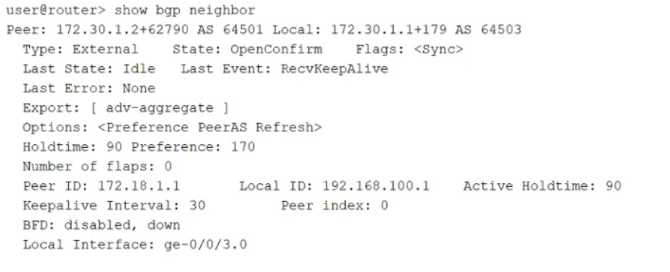
Referring to the exhibit,
what is indicated by the OpenConfirm state?
Reveal answer
Correct answer
-
D
BGP is waiting to receive a keepalive or notification message.
Explanation
In the BGP finite state machine, OpenConfirm indicates that the TCP session is already established and the BGP OPEN message exchange has successfully completed. At this point, both peers have agreed on critical session parameters such as BGP version, autonomous system numbers, hold time, and the BGP identifier. Because the OPEN messages have been processed, BGP transitions from OpenSent to OpenConfirm and then waits for the next control message that validates the session is operational.
Specifically, in OpenConfirm the local BGP process is waiting to receive a KEEPALIVE message from the neighbor, which confirms that the neighbor accepted the OPEN and is ready to bring the session to the Established state. If instead a NOTIFICATION message is received, it indicates an error condition and the session will be torn down. This is why option D is correct.
Option A describes OpenSent, where the router is waiting to receive an OPEN after sending its own OPEN. Option B aligns more closely with Connect, where BGP is still trying to complete the transport connection. Option C relates to Idle, where BGP waits for a start event or configuration to initiate the session. In data center BGP underlays and EVPN control planes, being stuck in OpenConfirm commonly points to policy mismatch, capability negotiation issues, or keepalive handling problems, rather than basic IP reachability.
No comments yet. Start the discussion.
-
D
-
Question 5
Single answer
Referring to the exhibit,
how much time must pass before a neighbor is considered down?

Reveal answer
Correct answer
-
D
3000 ms
Explanation
The exhibit shows BFD liveness detection configured under a BGP group with minimum-interval set to 1000 milliseconds. In Junos, BFD provides rapid failure detection by sending periodic BFD control packets between neighbors. The minimum-interval value is the negotiated minimum transmit and receive interval used for BFD control packets for that session. A neighbor is declared down when the local system fails to receive a certain number of consecutive BFD packets within the expected time window.
That time window is determined by the BFD detection time, which is calculated as the minimum-interval multiplied by the BFD multiplier. The multiplier represents how many BFD control packets can be missed before the session is considered failed. If the multiplier is not explicitly configured, Junos uses the default multiplier value of 3. Therefore, with minimum-interval set to 1000 ms and the default multiplier of 3, the detection time becomes 3000 ms. After approximately 3 seconds without receiving the expected BFD control packets, the BFD session transitions to down and BGP can react by treating the associated peer as unreachable for fast convergence.
This behavior is commonly used in data center underlays and EVPN fabrics to reduce convergence time compared to relying only on BGP hold timers.
No comments yet. Start the discussion.
-
D
- Unlock to see this question
- Unlock to see this question
62 questions locked
Unlock all 67 JN0-281 questions
You have tried 5 for free. The other 62 work the same way: answer first, then check.
- Questions
- 67, each with its answer
- Explanations
- 100% of questions explained
- Formats
- Single answer, Multiple answer
- Version
- 6.0
- Access
- 3 months from purchase
One-time payment
$49.00
Secure checkout