
HP
HPE7-A01 exam questions
Aruba Certified Campus Access Professional Exam
Try each question before you reveal its answer.
150 more HPE7-A01 questions with answers $49.00
Unlock all 155 questions-
Question 1
Single answer
Which feature supported by SNMPv3 provides an advantage over SNMPv2c?
Reveal answer
Correct answer
-
D
Encryption
Explanation
Encryption is a feature supported by SNMPv3 that provides an advantage over SNMPv2c. Encryption protects the confidentiality and integrity of SNMP messages by encrypting them with a secret key. SNMPv2c does not support encryption and relies on community strings for authentication and authorization, which are transmitted in clear text and can be easily intercepted or spoofed. Transport mapping, community strings, and GetBulk are features that are common to both SNMPv2c and SNMPv3. https://www.arubanetworks.com/techdocs/ArubaOS_86_Web_Help/Content/arubaos-solutions/snmp/snmp.htm https://www.arubanetworks.com/techdocs/ArubaOS_86_Web_Help/Content/arubaos-solutions/snmp/snmpv3.htm
No comments yet. Start the discussion.
-
D
-
Question 2
Multiple answer
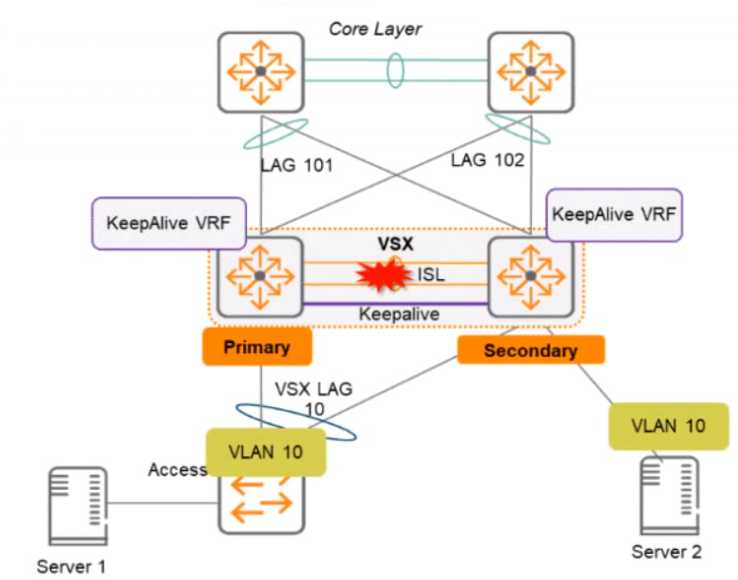
Two AOS-CX switches are configured with VSX at the the Access-Aggregation layer where servers attach to them An SVI interface is configured for VLAN 10 and serves as the default gateway for VLAN 10. The ISL link between the switches fails, but the keepalive interface functions. Active gateway has been configured on the VSX switches.
What is correct about access from the servers to the Core? (Select two.)
Reveal answer
Correct answer
-
D
Server 1 can access the core layer via both uplinks
-
E
Server 1 and Server 2 can communicate with each other via the core layer
Explanation
These are the correct statements about access from the servers to the Core when the ISL link between the switches fails, but the keepalive interface functions. Server 1 can access the core layer via both uplinks because it is connected to VSX-A, which is still active for VLAN 10. Server 2 can also access the core layer via its uplink to VSX-B, which is still active for VLAN 10 because of Active Gateway feature. Server 1 and Server 2 can communicate with each other via the core layer because they are in the same VLAN and subnet, and their traffic can be routed through the core switches. The other statements are incorrect because they either describe scenarios that are not possible or not relevant to the question. https://www.arubanetworks.com/techdocs/AOS-CX/10.04/HTML/5200-6728/bk01-
No comments yet. Start the discussion.
-
D
-
Question 3
Drag and drop
Match the solution components of NetConductor (Options may be used more than once or not at all.)

Reveal answer
Correct answer

No comments yet. Start the discussion.
-
Question 4
Ordering
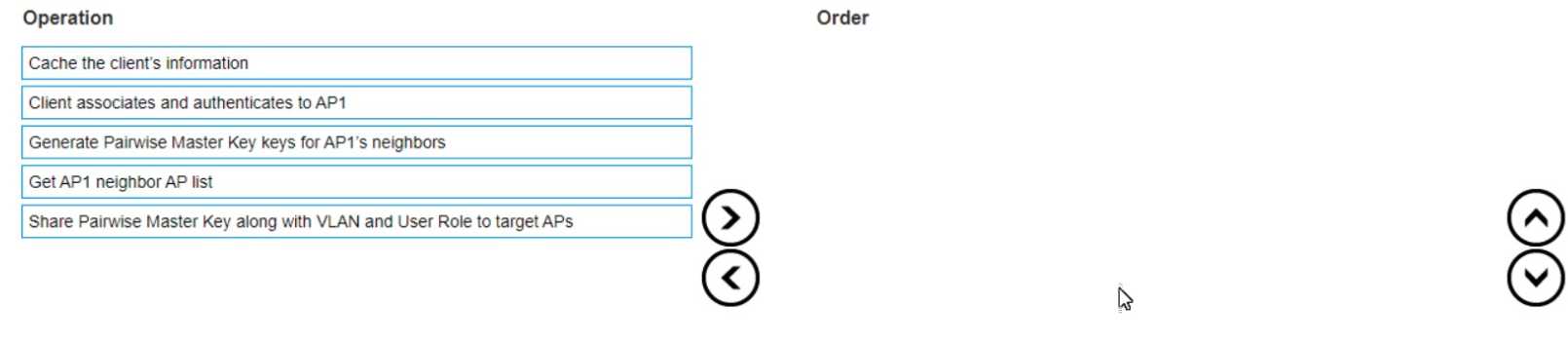
What is the order of operations tor Key Management service for a wireless client roaming from AP1 to AP2?
Reveal answer
Correct order
-
1
B
Client Associates and authenticates to AP1
-
2
A
Cache the client's information
-
3
C
Generate Parawise Master Key keys for AP1's neighbors
-
4
D
Get AP1 neighbour AP list
-
5
E
Share Parawise Master Key along with VLAN and User Role to target APs
No comments yet. Start the discussion.
-
1
B
-
Question 5
Single answer
Your manufacturing client is having installers deploy seventy headless scanners and fifty IP cameras in their warehouse These new devices do not support 802 1X authentication.
How can HPE Aruba reduce the IT administration overhead associated with this deployment while maintaining a secure environment using MPSK?
Reveal answer
Correct answer
-
C
Use MPSK Local to automatically provide unique pre-shared keys for devices.
Explanation
MPSK Local is a feature that can reduce the IT administration overhead associated with deploying devices that do not support 802.1X authentication while maintaining a secure environment. MPSK Local allows the switch to automatically generate and assign unique pre-shared keys for devices based on their MAC addresses, without requiring any configuration on the devices or an external authentication server. The other options are incorrect because they either require manual intervention by the installers or the MPSK gateway, or they do not provide unique pre-shared keys for devices. https://www.arubanetworks.com/techdocs/AOS-CX_10_08/UG/bk01-ch05.html https://www.arubanetworks.com/techdocs/AOS-CX_10_08/UG/bk01-ch06.html
No comments yet. Start the discussion.
-
C
- Unlock to see this question
- Unlock to see this question
150 questions locked
Unlock all 155 HPE7-A01 questions
You have tried 5 for free. The other 150 work the same way: answer first, then check.
- Questions
- 155, each with its answer
- Explanations
- 81% of questions explained
- Formats
- Single answer, Multiple answer, Drag and drop, Ordering
- Version
- 11.1
- Access
- 3 months from purchase
One-time payment
$49.00
Secure checkout