
Dell EMC
D-ISM-FN-02 exam questions
Dell Information Systems and Management Foundations
Try each question before you reveal its answer.
57 more D-ISM-FN-02 questions with answers $49.00
Unlock all 62 questions-
Question 1
Single answer
An organization wants to consume compute, network, and storage resources through a self-service portal. Which cloud service model provides this capability?
Reveal answer
Correct answer
-
B
Infrastructure as a Service
Explanation
Infrastructure as a Service (IaaS) is a cloud computing model that provides virtualized computing resources over the internet. It offers fundamental infrastructure services such as compute, storage, and networking, which users can provision and manage through a self-service portal. This model allows organizations to scale resources as needed and pay only for what they use.
No comments yet. Start the discussion.
-
B
-
Question 2
Multiple answer
What are the two benefits of using sub-LUN tiering?
Reveal answer
Correct answer
-
B
Granular control over data placement
-
C
Cost optimization
Explanation
Sub-LUN tiering allows for the movement of data at a more granular level within a Logical Unit Number (LUN), enabling:
Granular control over data placement: Specific data blocks can be moved to appropriate storage tiers based on access patterns.
Cost optimization: Frequently accessed data resides on high-performance (and more expensive) storage, while less accessed data is moved to cost-effective storage, optimizing overall storage costs.
Other options:
Reduced need for storage capacity: Not directly impacted by sub-LUN tiering.
Reduced need for storage tiering policies: Policies are still required to manage data movement.
Simplified storage management: While sub-LUN tiering adds efficiency, it may introduce complexity in management.
No comments yet. Start the discussion.
-
B
-
Question 3
Drag and drop
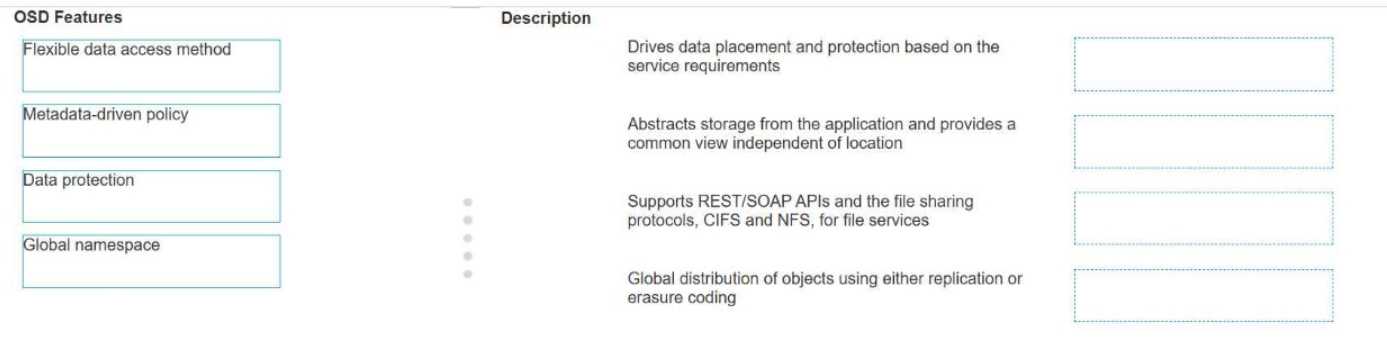
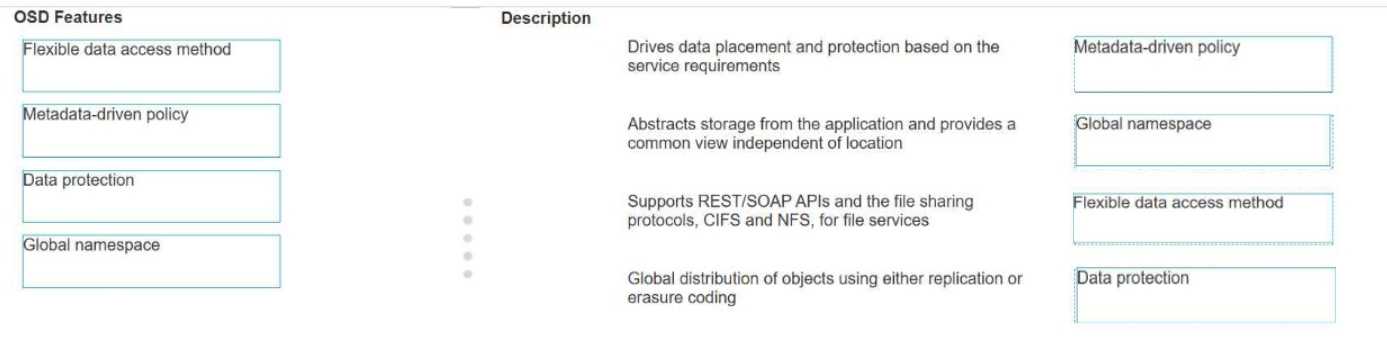
Match each OSD (Object Storage Device) feature with its description:
Reveal answer
Correct answer
No comments yet. Start the discussion.
-
Question 4
Single answer
Which layer of the OSI model does a router primarily operate at?
Reveal answer
Correct answer
-
C
Layer 3
Explanation
Routers are networking devices that determine the optimal path for data packets to travel across networks. They primarily operate at Layer 3 of the OSI model, known as the Network Layer. This layer is responsible for logical addressing and routing, enabling data to move between different networks.
Layer 2 (Data Link Layer): Handles physical addressing and is the primary domain of switches.
Layer 3 (Network Layer): Manages logical addressing (IP addresses) and routing; the main operational layer for routers.
Layer 4 (Transport Layer): Ensures reliable data transfer but is not the primary layer for routers.
Layer 7 (Application Layer): Interfaces with end-user applications; not relevant to routing functions.
No comments yet. Start the discussion.
-
C
-
Question 5
Single answer
An organization needs to adhere to compliance and lower the cost of the primary storage. What process should they implement?
Reveal answer
Correct answer
-
B
Data archiving
Explanation
Data archiving involves moving infrequently accessed data to a separate storage system, freeing up space on primary storage and reducing costs. It also aids in compliance by retaining data for specified periods, as required by various regulations.
Data backup: Creates copies of data for recovery purposes but doesn't necessarily reduce primary storage usage.
Data archiving: Moves less frequently accessed data to cost-effective storage, aiding compliance and reducing primary storage costs.
Data encryption: Secures data but doesn't impact storage costs or compliance retention.
Data compression: Reduces data size but may not meet compliance requirements for data retention.
No comments yet. Start the discussion.
-
B
- Unlock to see this question
- Unlock to see this question
57 questions locked
Unlock all 62 D-ISM-FN-02 questions
You have tried 5 for free. The other 57 work the same way: answer first, then check.
- Questions
- 62, each with its answer
- Explanations
- 98% of questions explained
- Formats
- Single answer, Multiple answer, Drag and drop
- Version
- 6.0
- Access
- 3 months from purchase
One-time payment
$49.00
Secure checkout